12
Uno sguardo, un'intesa
ENGLISH
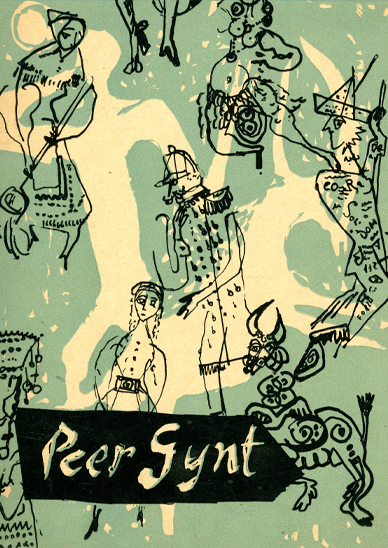
A glance, an understanding. Although one might think that the first meeting between Emanuele Luzzati and Vittorio Gassman took place on the occasion of the staging of Peer Gynt, in reality, this episode occurred even earlier. Gassman was struck by the Master’s work during Lea Lebowitz, the 1947 show that Luzzati staged with Alessandro Fersen and which Gassman attended. Gassman himself, in a letter to Luzzati, wrote: “I remember the beautiful things you did for Lea Lebowitz, and I am sure that this time you will find equally exact solutions.” An investment that the young Gassman decided to make for his Peer Gynt. Gassman, with just a single first approach, managed to capture Luzzati’s visionary talent. In fact, without much reservation, the “Mattatore” (Gassman) asked the set designer, on the occasion of the staging of Ibsen’s work, to represent bestiality through masks and costumes. Again in an exchange of letters between the two, Gassman wrote: “I will keep the acting and the business on a tone of exasperated vulgarity, of foul carnality: obscene noises, disgusting embraces, etc. Take this into account. In short, they are not lyrically fantastic characters, but rather expressionistic nightmares, somewhere between abortion and the devil.” What Gassman was able to grasp, beyond Luzzati’s imaginative touch, was his profound knowledge of things. Luzzati, even before being a set designer, was a man. A man of boundless curiosity and an insatiable hunger for knowledge. He engaged with many themes, from theater to literature, from music to religion, and this allowed him to interpret every subject by dressing himself in multiple suggestions while always maintaining his imperturbable essence.
GIULIA ORLANDI
FRANÇAIS
Un regard, une entente. Bien que l’on puisse penser que la première rencontre entre Emanuele Luzzati et Vittorio Gassman a eu lieu à l’occasion de la mise en scène de Peer Gynt, cet épisode s’est en réalité produit encore plus tôt. Gassman fut foudroyé par l’œuvre du Maestro lors de Lea Lebowitz, le spectacle de 1947 que Luzzati monta avec Alessandro Fersen et auquel Gassman assista. Gassman lui-même, dans une lettre à Luzzati, écrivit : « Je me souviens des très belles choses que tu as faites pour Lea Lebowitz, et je suis sûr que tu trouveras cette fois des solutions tout aussi exactes ». Un investissement que le jeune Gassman décida de faire pour son Peer Gynt. Gassman, dès cette première approche, réussit à saisir le talent visionnaire de Luzzati. En effet, sans trop de réserve, le « Mattatore » (Gassman) demanda au scénographe, à l’occasion de la mise en scène de l’œuvre d’Ibsen, de représenter la bestialité à travers des masques et des costumes. Encore dans un échange de lettres entre les deux, Gassman écrivit : « Je maintiendrai le jeu et les jeux de scène sur un ton de vulgarité exaspérée, de turpide carnalité : bruits obscènes, étreintes dégoûtantes, etc. Tiens-en compte. Bref, ce ne sont pas des personnages lyriquement fantastiques, mais plutôt des cauchemars expressionnistes, entre l’avortement et le démon ». Ce que Gassman sut saisir, au-delà du trait imaginatif de Luzzati, ce fut sa profonde connaissance des choses. Luzzati, avant même d’être scénographe, était un homme. Un homme à la curiosité démesurée et à la faim insatiable de connaissances. Il s’est confronté à de très nombreux thèmes, du théâtre à la littérature, de la musique à la religion, et cela lui a permis d’interpréter chaque sujet en se parant de multiples suggestions et en conservant toujours son essence imperturbable.
GIULIA ORLANDI
DEUTSCH
Ein Blick, ein gegenseitiges Verstehen. Obwohl man annehmen könnte, dass sich Emanuele Luzzati und Vittorio Gassman erstmals bei der Inszenierung von Peer Gynt begegneten, reicht ihre erste Begegnung tatsächlich weiter zurück. Gassman war bereits von Luzzatis Arbeit beeindruckt, als er 1947 die Aufführung von Lea Lebowitz sah, die Luzzati gemeinsam mit Alessandro Fersen inszeniert hatte. In einem Brief an Luzzati schrieb Gassman: »Ich erinnere mich an die wunderbaren Dinge, die du für Lea Lebowitzgeschaffen hast, und ich bin sicher, dass du auch diesmal ebenso treffende Lösungen finden wirst.« Dieses Vertrauen setzte der junge Gassman in seine Inszenierung von Peer Gynt. Schon bei dieser ersten Begegnung erkannte er Luzzatis visionäre Begabung. Ohne Zögern bat der »Mattatore« den Bühnenbildner, für Ibsens Werk die Bestialität durch Masken und Kostüme sichtbar zu machen. In einem weiteren Brief schrieb Gassman: »Ich werde das Spiel und die Szenen in einem Ton äußerster Vulgarität und roher Sinnlichkeit halten: obszöne Geräusche, widerwärtige Umarmungen und Ähnliches. Berücksichtige das bitte. Es handelt sich nicht um lyrisch-fantastische Figuren, sondern um expressionistische Albträume irgendwo zwischen Missgeburt und Teufel.« Was Gassman über Luzzatis fantasievolle Bildsprache hinaus erkannte, war dessen tiefes Verständnis der Welt. Noch bevor Luzzati Bühnenbildner war, war er vor allem ein Mensch – ein Mensch von grenzenloser Neugier und unstillbarem Wissensdurst. Er setzte sich mit Theater, Literatur, Musik und Religion auseinander und vermochte es dadurch, jedes Thema mit vielfältigen Anregungen zu interpretieren, ohne jemals seine unverwechselbare poetische Handschrift zu verlieren. GIULIA ORLANDI
ESPAÑOL
Una mirada, un entendimiento. Aunque se pueda pensar que el primer encuentro entre Emanuele Luzzati y Vittorio Gassman ocurrió por la puesta en escena de Peer Gynt, en realidad este episodio se verificó aún antes. Gassman quedó deslumbrado por la obra del Maestro durante Lea Lebowitz, el espectáculo de 1947 que Luzzati montó junto a Alessandro Fersen y al cual Gassman asistió. El propio Gassman, en una carta a Luzzati, escribió: “Recuerdo las hermosísimas cosas que hiciste para Lea Lebowitz, y estoy seguro de que esta vez encontrarás soluciones igualmente exactas”. Una inversión que el joven Gassman decidió hacer para su Peer Gynt. Gassman, con un solo primer acercamiento, logró captar el talento visionario de Luzzati. De hecho, sin demasiados reparos, el “Mattatore” (Gassman) pidió al escenógrafo, con motivo de la puesta en escena de la obra de Ibsen, que representara la bestialidad a través de máscaras y vestuarios. De nuevo en un intercambio de cartas entre los dos, Gassman escribió: “Mantendré la actuación y las acciones secundarias en un tono de exasperada vulgaridad, de torpe carnalidad: ruidos obscenos, abrazos asquerosos, etc. Tenlo en cuenta. En resumen, no son personajes líricamente fantásticos, sino más bien pesadillas expresionistas, entre el aborto y el demonio”. Lo que Gassman supo captar, más allá del trazo imaginativo de Luzzati, fue su profundo conocimiento de las cosas. Luzzati, antes incluso que escenógrafo, era un hombre. Un hombre de una curiosidad desmedida y de un hambre insaciable de conocimiento. Se enfrentó a muchísimos temas, desde el teatro hasta la literatura, desde la música hasta la religión, y esto le dio la oportunidad de interpretar cada sujeto vistiéndose de múltiples sugestiones y manteniendo siempre su imperturbable esencia.
GIULIA ORLANDI
indice
WebDesign & Content by Paroledavendere - Engineered by Pulsante
DATA WEB AGENCY
advent-c v2.0